
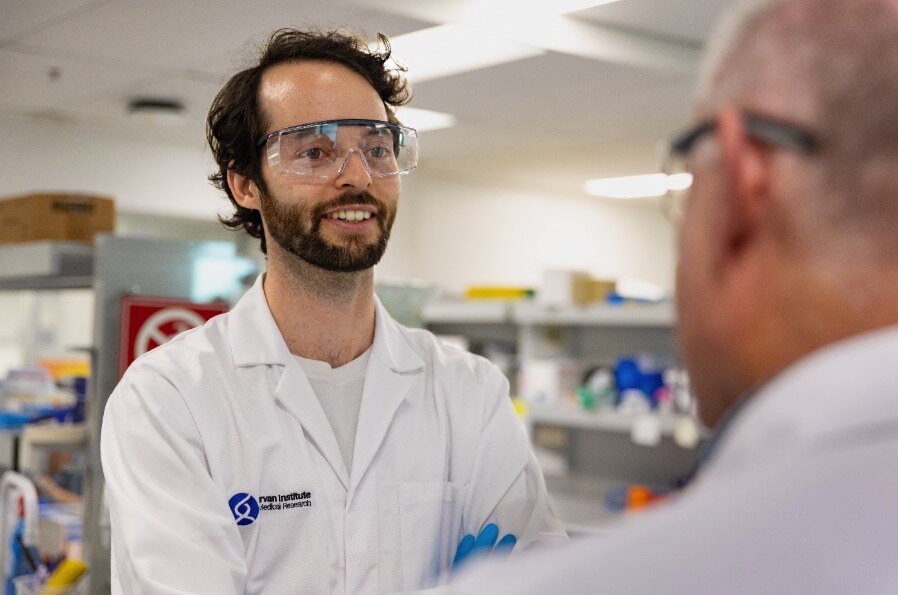
At the Garvan Institute of Medical Research, Dr Etienne Masle-Farquhar runs the Arthritis Research Lab, and is the recipient of an Arthritis Australia Fellowship co-funded with Arthritis NSW (now The Arthritis Movement). His project, “Leukocytes, acquired mutations and biomarkers in osteoarthritis,” uses cutting-edge single-cell genomics to understand what immune cells are doing inside the joints of people with arthritis.
“The ultimate goal of this research is to cure arthritis, or at the very least, to radically change the way that we manage arthritis,” Etienne explains. “And that goes all the way from more rapid diagnosis, better monitoring of disease and treatment outcomes, all the way through to more effective therapies.” His lab has built precious partnerships with St Vincent’s Private Clinic, where every year around 1,000 hip and knee replacements are performed. Tissue that would normally be incinerated is now recycled into a national biobank with samples from over 15 hospitals, a long-term resource Australian researchers can apply new technologies to for decades to come.
The work is challenging the long-held belief that osteoarthritis is purely a disease of “wear and tear.” Early findings show immune cells infiltrating osteoarthritic joints to a degree comparable with rheumatoid arthritis. “It’s also a hopeful finding,” Etienne says, “in the sense that it means that this avenue of immune cells and immunology that wasn’t being applied to osteoarthritis in the past very much should be and can be.” Hot off the press in the past few weeks, his team has begun pre-clinical testing of novel drugs designed to target a specific type of immune cell that may be driving rheumatoid arthritis flares.
Etienne’s motivation is both intellectual and deeply personal. “About a year after I started this research program, I actually developed arthritis myself. That was a very hard time in my life and probably the hardest thing I’ve ever gone through.
I think it gives me a very good idea of the challenges that people with arthritis face in their day to day, and the fact that we need to do something about it.”
Funding makes the work possible, and there are hidden costs the public rarely sees. Transporting a single tissue sample from the hospital to the lab costs $400; some of the cutting-edge experiments cost $20,000–$30,000 each. “Arthritis Australia and other peak bodies and research institutes like Garvan,” he says, “do work that is really critical. Everyone who’s watching should be speaking and shouting out… we need to collectively change the way that we sometimes ignore arthritis in our community.”