
Quick links
- What is romosozumab?
- What benefit can you expect from your treatment?
- Stopping romosozumab
- How will you be checked while on romosozumab?
- How is romosozumab given?
- When should it be given?
- What is the dosage?
- Can other medicines be taken with romosozumab?
- Are there any side effects?
- What precautions are necessary?
- How to store romosozumab
- Questions?
- Your doctor’s contact details
- Important Things to Remember
What is romosozumab?
Romosozumab (brand name Evenity®) is a medicine used to treat osteoporosis (bone loss). Osteoporosis is a common condition which causes bones to become fragile and brittle so that they break (fracture) more easily. Fractures are painful and restrict a person’s ability to carry out their normal daily tasks. Romosozumab reduces the risk of a broken bone or fracture.
What benefit can you expect from your treatment?
You will likely not feel any different after taking romosozumab. Taking romosozumab can help to increase bone strength and reduce the chance of fracture.
Stopping romosozumab
If you stop or delay your romosozumab treatment, your disease may get worse. Keep taking your treatment, unless advised by your rheumatologist to stop or unless serious side effects occur (see Side effects).
If you stop romosozumab for any reason you must contact your rheumatologist. Failure to do so may mean that your treatment may no longer be funded.
How will you be checked while on romosozumab?
Medicines like romosozumab are very expensive and are funded by Medicare. Certain conditions must be met to receive it.
Romosozumab will only be given if your osteoporosis is severe (very low bone mineral density) and you are at high risk of a fracture (i.e. have already had a fracture).
A blood test is needed before starting your treatment. Regular blood tests are not required, however may be requested by your doctor if you have any side effects.
How is romosozumab given?
Romosozumab is injected just under the skin of the thigh or abdomen (subcutaneously). It is best to avoid (if possible) any areas of skin with rashes, skin breaks, tenderness, hardness or bruising.
The prefilled autoinjector or syringe should be taken out of the refrigerator 30 minutes before injecting to allow it to reach room temperature. Do not heat it in other ways (e.g. microwave). Do not shake or freeze the injection.
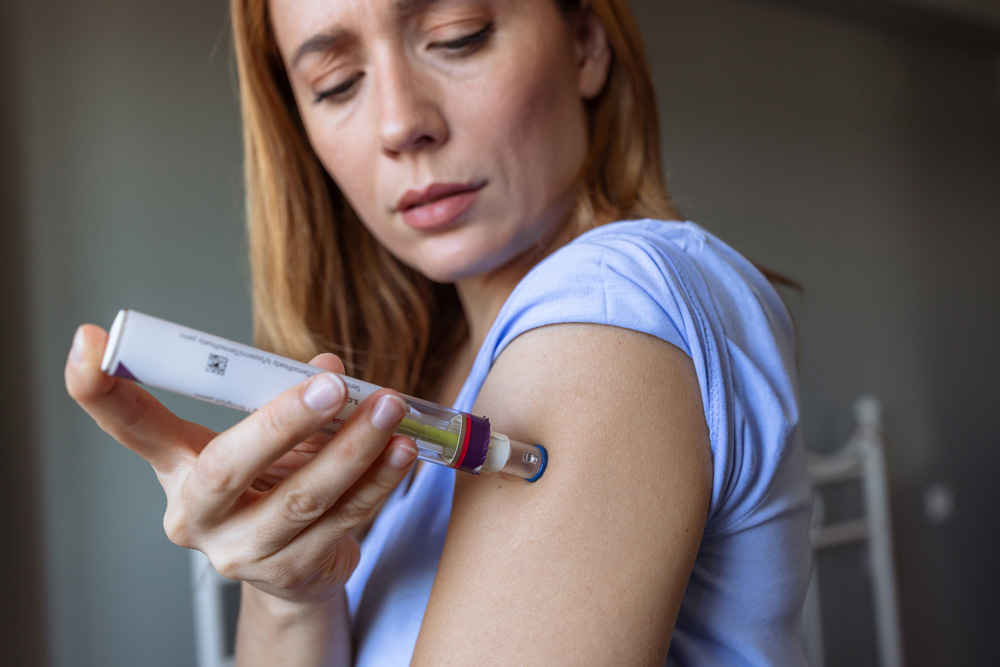
Romosozumab can be injected by your doctor, nurse, carer, or by yourself. If injecting yourself, be sure to follow the detailed instructions carefully to ensure the best response. It is important to change the injection site each time.
When should it be given?
Romosozumab should be given as two subcutaneous injections every month.
If you miss an injection: have the next injection as soon as you remember, then subsequent injection a month later and then continue as you normally would with monthly injections. Do not inject a double dose to make up for a missed dose. If you have missed more than one dose or are not sure what to do, check with your doctor or pharmacist.
What is the dosage?
Romosozumab is a solution for injection that comes in a pre-filled syringe or autoinjector ‘pen’ device. Each injection contains 105mg of romosozumab. For osteoporosis fracture risk reduction, the usual dose of romosozumab is 210mg (two pens at a time) injected each month for 12 months. The benefit of romosozumab past 12 months is not known.
It is common to change to an anti-resorptive treatment such as denosumab (Prolia®) or zoledronic acid (Aclasta®) after the 12-month course of romosozumab to ‘lock in’ the improvement in bone strength.
Can other medicines be taken with romosozumab?
Are there any side effects?
Romosozumab is generally very well tolerated, but everyone is different, and you might experience side effects with your treatment. Tell your doctor if you notice side effects that you think are caused by this medicine. Many side effects disappear when romosozumab treatment is stopped.
Most common side effects
- In clinical trials, patients taking romosozumab reported upper respiratory tract (nose, throat and sinus) infections. These infections occurred at almost the same rate as people not taking romosozumab. Some infections may need treatment and romosozumab may need to be stopped for a while if you develop an infection, so it is important to contact your doctor for advice.
- Arthralgia (joint/back pain) was also commonly reported in patients taking romosozumab, however at a similar rate to people not taking the medicine.
- Injection site reaction (redness, bruising) is common.
What precautions are necessary?
Hypocalcaemia (low calcium)
- Your blood may become low in calcium if you start taking romosozumab without adequate vitamin D and calcium. People low in calcium often report lip or hands/feet tingling, as well as muscle cramps.
- Your doctor will normally recommend taking a vitamin D and calcium supplement prior to and during romosozumab treatment.
Myocardial infarction (heart attack) and stroke
- Go straight to the nearest hospital Emergency Department if you have any of the following symptoms of:
- heart attack (chest pain, shortness of breath, lightheadedness or dizziness)
- stroke (headache, numbness/weakness in face, arms, or legs, difficulty talking, changes in vision or loss of balance).
- If you have a history of heart disease or stroke, you must discuss this with your doctor before starting romosozumab.
- Romosozumab is not recommended as first-line therapy if you have had a heart attack or stroke. Your rheumatologist will discuss the risks with you if you have a history of heart disease without a prior heart attack.
Osteonecrosis of the jaw
- Damage to the jaw bone occurs rarely in people using romosozumab, usually when they have a tooth extraction and/or local infection.
- Patients should discuss the risks/benefits of the dental procedure with their dentist.
Atypical femur fracture
- Very rarely, long-term use of bone-strengthening medicines can cause a fracture in the middle of the femur (long bone of the leg). Please let your doctor know if you have any ongoing discomfort in your thigh when taking romosozumab.
Vaccines
- If you are taking romosozumab you should have any vaccines that you have been recommended.
- COVID-19, pneumococcal, non-live herpes zoster vaccines (Shingrix) and the yearly influenza vaccinations are encouraged.
- For more information on vaccination including the COVID-19 vaccination go to the ARA website.
Surgery
- No break in treatment is required if you are due to undergo surgery.
Use in pregnancy and when breastfeeding
- It is important to discuss with your doctor if you are planning a pregnancy while on romosozumab. There have been no clinical studies using romosozumab in pregnant women, so the risk to the baby is unknown.
- Do not breastfeed if you are taking romosozumab as it is uncertain how much of the medicine might be excreted in breastmilk.
- More detailed information may be available here
How to store romosozumab
- Store romosozumab in the refrigerator between 2 and 8 degrees.
- It is recommended to allow romosozumab to come to room temperature before it is given.
- Keep all medicines out of reach of children.
Questions?
If you have any questions or concerns write them down and discuss them with your doctor.
Your doctor’s contact details
You should see your rheumatologist regularly to make sure the treatment is working and to minimise any possible side effects.
Important Things to Remember
- You must see your rheumatologist/GP regularly to make sure the treatment is working and check for possible side effects.
- If you are worried about any side effects, you should contact your rheumatologist/GP as soon as possible.
- Romosozumab is not recommended for people who have had a heart attack or stroke previously. Please tell your rheumatologist if you have had either a heart attack, stroke or a history of low calcium in the blood (hypocalcaemia).
- Do not stop using romosozumab until advised by your rheumatologist/GP.
Disclaimer
This Information Sheet has been prepared using materials obtained from various sources which have been reviewed by the Australian Rheumatology Association (ARA). It contains general information only and does not contain a complete or definitive statement of all possible uses, actions, precautions, side effects or interactions of the medicines referenced. This information is not intended as medical advice for individual conditions nor for making an individual assessment of the risks and benefits of taking a particular medicine. Decisions regarding the assessment and treatment of patients are the sole responsibility of the treating medical professional, exercising their own clinical judgment and taking into account all of the circumstances and the medical history of the individual patient.
ARA has used all reasonable endeavours to ensure the information on which this Information Sheet is based is accurate and up to date. However, the ARA accepts no responsibility or liability for the accuracy, currency, reliability and/or completeness of the information contained in this Information Sheet. To the maximum extent permitted by law, the ARA expressly disclaims any liability for any injury, loss, harm or damage arising from or in connection with use of and reliance on the information contained in this Information Sheet.
Page updated May 2026