
Getting the care you deserve

Quick links
A person with arthritis in conversation with a healthcare professional. The dynamic should feel collaborative and relaxed — two people talking together, not a doctor delivering information to a patient.
Every person living with arthritis has the right to good care. Learn what that looks like, how to check your care is on track, and what to do if it isn’t.
Good care isn’t just about getting the right medicines. It’s about being listened to, involved in decisions and supported as a whole person. Whatever your condition and wherever you’re treated, you have the same fundamental rights as anyone receiving health care in Australia — set out in the Australian Charter of Healthcare Rights.
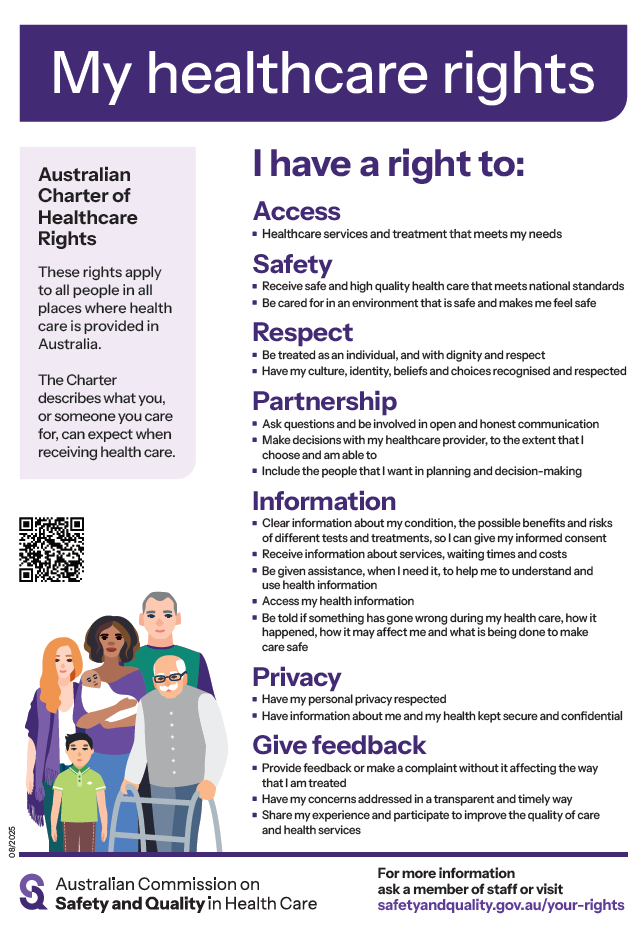
The Australian Charter of Healthcare Rights describes the rights that you or someone you care for can expect when receiving health care. These rights apply to all people in all places where health care is provided in Australia.
This page gives you practical tools to check your own care, ask better questions at appointments and speak up if your needs aren’t being met. You deserve care that works for you. This page will help you get it.
Your Healthcare Rights
No matter what type of arthritis or musculoskeletal condition you have, you have the same rights as everyone receiving health care in Australia. The Australian Charter of Healthcare Rights sets out seven of them. The questions and checklists on this page are practical ways to put these rights into action.
- Access — you can get the care you need, when and where you need it.
- Safety — you receive safe, high-quality care that meets agreed national standards.
- Respect — you are treated with dignity, and your culture, beliefs and values are respected.
- Partnership — you are an equal partner in decisions about your care, and can include the people you choose.
- Information — you get clear information about your condition, your options and any costs, in a way you can understand.
- Privacy — your personal information is kept private and secure.
- Give feedback — you can comment on your care or make a complaint, and have your concerns dealt with, without it affecting how you are treated.
Am I Getting Quality Care?
These questions put your healthcare rights into practice. Use them to check whether your own care measures up. Read through the list and think about your own experience. If you answer “no” to one or more questions, see the section below on how to speak up.
Your healthcare providers
- Do I know how to get help from my healthcare providers ?
- Do I know what the role of each healthcare provider is?
- Do my healthcare providers put my overall wellbeing — not just my condition — at the centre of my care?
- Do the healthcare providers I see respect my personal background, culture and values?
- Do members of my care team communicate well with each other, so my care is well organised?
- Do my healthcare providers review my treatment regularly and make changes if it isn’t working?
Your ongoing management
- Do I have a management plan that reflects my goals and what I want from life?
- Do my healthcare providers ask me about pain and how it affects my daily life — not just my physical symptoms?
- Do my healthcare providers ask about my emotional wellbeing at least once a year?
- Have I been offered a referral to support services if I need them?
- Have I been given information and education about my condition and how to manage it?
- Have I been helped to access services to keep me physically active in a way that suits me?
- If my treatments affects my immune system, have I been advised about any vaccinations I need?
- Has my risk of any related conditions been assessed?
Your rights
- Do I have the knowledge and support I need to make informed decisions together with my healthcare providers?
- Have I been taught how to take care of myself and play an active part in managing my condition?
- Do I have a way to contact my healthcare providers between appointments if my symptoms get worse?
Questions to Ask at Your Appointment
Taking a list of questions to your appointment can help you get the most out of it. You don’t have to ask everything at once — pick the questions that matter most to you right now.
About your diagnosis
- What type of arthritis or musculoskeletal condition do I have?
- What caused it, and are there any risk factors I should know about?
- What are the likely changes to my condition over time?
- Are there other conditions I should be checked for?
About your treatment
- What treatment options are available to me?
- What are the risks and benefits of each option?
- How long before I might notice a difference from my treatment?
- Do I need any tests or monitoring, and how often?
- What should I do if my symptoms get worse, or if my treatment causes problems?
About your healthcare providers and plan
- Who is involved in my care, and how do I contact them?
- Who do I call if I have an urgent concern between appointments?
- Do I have a management plan? Can we review it together?
- Are there other health professionals who could help me — such as a physiotherapist, dietitian or psychologist?
- Are there support services or community programs available to me?
About your everyday life
- How do I stay as active as possible with my condition?
- What changes to my diet or lifestyle might help?
- How do I manage a flare-up?
- How might my condition affect my work, study or family life?
What Your Healthcare Team Should Do
Good care is a two-way relationship. Here is what you should be able to expect from your healthcare providers at each stage of your care.
When you are first diagnosed
- Put you at the centre of your care
- Connect you with the right care promptly, including specialist referrals if needed
- Carry out any tests needed to identify the right care or treatment
- Start care or treatment within a clinically appropriate timeframe
- Provide you with clear information about your condition, your treatment options, and what to expect
- Develop a management plan with you — one that reflects your goals, culture and wellbeing, not just your disease
As you manage your condition day-to-day
- Review your condition regularly, more often if your symptoms aren’t well controlled
- Adjust your treatment based on how you are responding
- Explain the risks and benefits of your treatment options in plain language
- Ask about your pain, fatigue and emotional wellbeing — not just your physical symptoms
- Give you a clear way to contact someone between appointments
Over the long term
- Continue regular review appointments — even if less frequent
- Check in on your pain and emotional wellbeing at every visit
- Talk to you about a plan for flare-ups
- If your treatment affects your immune system, advise you about any vaccinations you need
- Monitor your risk of related conditions
- Discuss any options to adjust your treatment over time, with the final decision resting with you
Clinical Care Standards: What Are They?
Your Healthcare Rights apply to everyone. For some conditions, a clinical care standard goes further — spelling out in detail what good care should look like.
Clinical care standards are documents that describe the level of care all Australians should receive. They are developed by peak medical bodies or groups like the Australian Commission on Safety and Quality in Healthcare, and are based on the best available evidence. They set out what your healthcare team should offer you — and give you a way to check if your care is meeting the standard.
For some arthritis and musculoskeletal conditions, a clinical care standard exists to guide your diagnosis, treatment and ongoing management. These standards apply no matter where you live or what type of health service you use.
Rheumatoid Arthritis Clinical Care Standard – for Consumers
Juvenile Idiopathic Arthritis (JIA) Standards of Care – for Consumers
Osteoarthritis of the Knee Clinical Care Standard – Consumer Guide
How to Speak Up If Your Care Isn't Right
If you answered “no” to any of the questions above, you have the right to speak up. Here are some steps you can take.
Start with your healthcare provider
The first step is to raise your concerns with a member of your healthcare team. You can use this page as a starting point for that conversation. Most concerns can be resolved at this level.
This might be your GP
If you see a specialist privately, your GP can advocate on your behalf. They may also be able to refer you for a second opinion if needed.
Use the hospital complaints process
If your care is through a public hospital or clinic, the hospital should have a formal process for raising concerns. You can usually find this on their website.
Get involved in advocacy
You can also take a bigger role in improving care for everyone living with arthritis and musculoskeletal conditions. Some options include getting involved with Arthritis Australia as a consumer advocate, or writing to your local MP about the need for better services in your area.
Remember — you are the most important person in your healthcare team. You have the right to be heard, respected and involved in every decision about your care.

Healthcare providers

Understanding arthritis

Navigating the Australian Healthcare System